Lahore’s air turns hazardous as AQI crosses 530 and the city tops the world’s pollution ranking
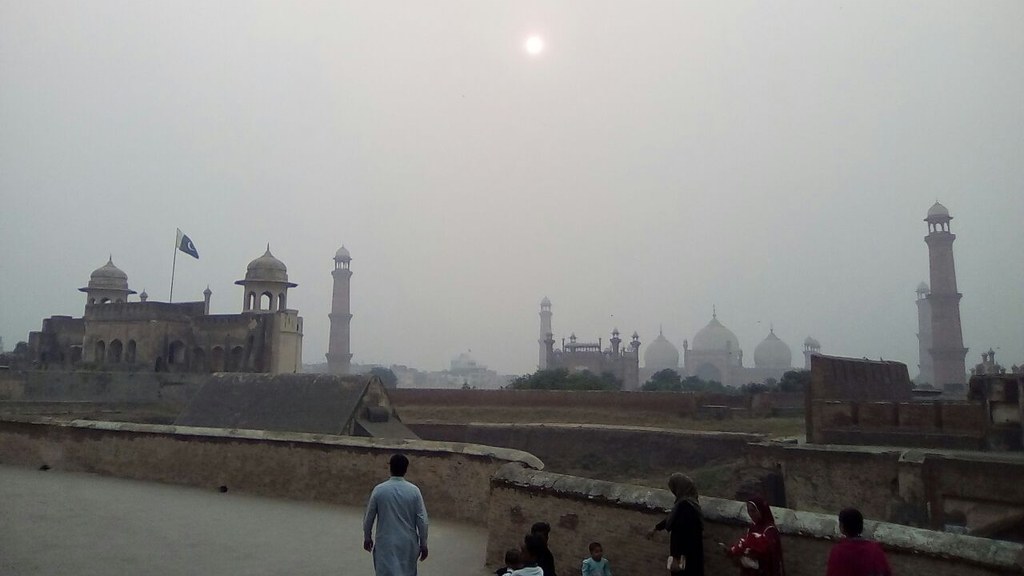
File photo: Badshahi Mosque seen through haze from Lahore Fort (Wikimedia Commons, CC BY-SA 4.0). The photo shows Lahore in hazy conditions; it is not today's AQI reading.
Lahore woke on Monday to air it could barely breathe. The Air Quality Index pushed past 530, into the hazardous band, and the city sat at the top of the world’s most polluted list. On the streets the haze hung thick as fog, and in the worst-hit neighbourhoods even a short walk outside felt like hard work.
The 8am reading
According to the international monitoring platform IQAir, Lahore recorded an AQI of 535 at 8am. Fine particulate matter, PM2.5, stood at 343 micrograms per cubic metre. Those are the tiny particles doctors worry about most, because they travel deep into the lungs and pass into the bloodstream. Between 9am and 10am, IQAir’s global ranking had Lahore first in the world — well clear of Cairo in second place, at 226.
The rest of Punjab is choking too
This was not Lahore’s problem alone. Five of Pakistan’s six most polluted cities in IQAir’s Monday-morning live ranking were in Punjab. Gujranwala led it at 606, followed by Lahore at 509, Faisalabad and Multan at 310 each, and Sialkot at 260, with Peshawar sixth at 216. The numbers kept shifting as the morning went on — later updates put Gujranwala at 675 and Lahore at 535. Inside the city the spread was just as stark: APP reported Iqbal Town at 902, Paragon City at 698, Chaman Park at 619 and Barki Road at 569, against Model Town at 471, DHA Phase 5 at 412, Bedian Road at 358 and Askari X at 298.
Where the smoke is coming from
Behind the worsening air sits the burning in the fields. An analysis by the environmental monitoring website HamariHawa, based on NASA satellite data, found 13,241 fire spots in Pakistani Punjab between 1 and 29 October, against 3,158 in Indian Punjab — more than four times as many. Around 92 per cent of the fires on the Pakistani side were on farmland, most likely crop-residue burning. About half the month’s total, 6,655 spots, appeared in the last seven days of October alone, and 29 October saw 1,327 in a single day. Okara recorded the most, at 2,144, followed by Gujranwala at 1,011 and Nankana Sahib at 1,003. That smoke joins vehicle exhaust, factory emissions and everything else in the air, and weak winds and atmospheric inversions then hold it close to the ground.
The argument over October
October itself is now a point of dispute between the government and independent analysts. Punjab Senior Minister Marriyum Aurangzeb’s figures, shared with Dawn, put Lahore’s average US AQI (PM2.5) at 180.5 for October 2026, down from 204.6 in 2025, 213 in 2024 and roughly 193 to 195 in 2022 and 2023 — and the first October in five years with no reading above 300, the highest being 262 on 31 October. The Pakistan Air Quality Initiative tells a cooler story: average PM2.5 did fall 27 per cent year-on-year across 26 monitoring sites, but only about 4 per cent once weather is stripped out, because a deeper nighttime mixing layer gave pollutants more room to disperse. PM2.5 still breached Pakistan’s prescribed daily limit on every single day of October. PAQI’s forecast, issued on 1 November, has PM2.5 climbing to 149 micrograms per cubic metre by Wednesday 4 November, around 49 per cent above October’s average. The Meteorological Department expects dry weather to continue, with no rain on the way — so no natural clearing is in sight. October’s enforcement drive had fined 1,763 smoke-emitting vehicles Rs5.5 million, impounded 739 vehicles, and sealed 41 factories and 146 restaurants after inspecting 2,018 industrial units across Lahore Division. Monday morning showed how far that still leaves the city to go.