Lahore again world’s most polluted city as AQI hits 465; Gujranwala 661
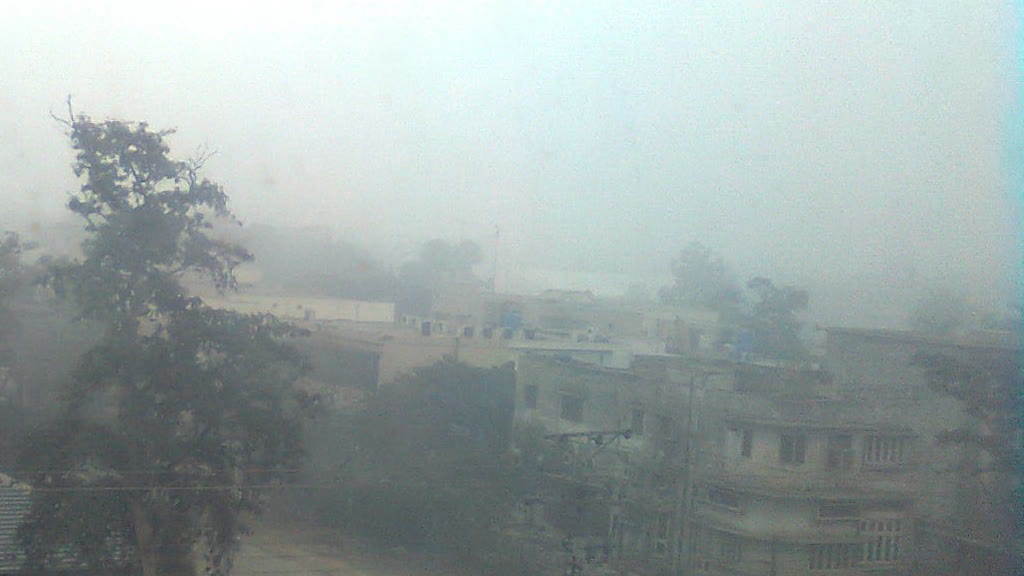
File photo: a hazy winter morning in Lahore. The city's hourly AQI reached 465 on Friday morning. (Jugni / Wikimedia Commons, CC BY-SA 3.0)
Lahore is once again the world’s most polluted major city. Between 7am and 8am on Friday, the city’s hourly Air Quality Index (AQI) reached 465, a level classified as hazardous. Gujranwala recorded an even higher 661, and Multan 641.
The bad air is not Lahore’s problem alone. Several Punjab cities are breathing the same toxic haze. Sargodha recorded an AQI of 289, Sialkot 232, Rahim Yar Khan 228 and Bahawalpur 198. In a separate ranking of Pakistani cities, Gujranwala topped the list at 661, followed by Multan at 641 and Lahore at 426. IQAir’s own live reading put Lahore higher still, at 495, with Gujranwala at 562 and Multan at 524 — the monitors disagree on the exact number, but they agree on the picture: the air is not fit to breathe.
What the smog does to health
Fine particulate matter (PM2.5) at these levels can aggravate respiratory and cardiovascular conditions, and the people most at risk are children, the elderly and anyone already living with a breathing or heart condition. Residents have been advised to keep outdoor activity to a minimum, keep windows shut, wear a protective mask when they do go out, and run an air purifier indoors. Some parts of Lahore fared worse than the city average: Multan Road, DHA Phase 6 and GT Road all recorded an AQI of 500, Egerton Road 470, Gulberg III 439 and Shahdara 434.
Crackdown on brick kilns continues
The Punjab Environment Protection and Climate Change Department says its enforcement drive against pollution sources is continuing. Between January 1 and November 18, teams carried out 84,370 inspections of brick kilns across the province, demolishing 1,429 units, sealing 968 and registering 1,248 cases, with fines totalling Rs178 million. During the critical smog period from September 1 to November 18, there were 29,999 visits, 519 kilns demolished, 494 sealed and 408 cases registered, with fines of Rs101.45 million. On November 18 alone, 552 kilns were inspected, 22 demolished and 19 sealed.
Secretary Silwat Saeed has directed sustained field enforcement, while Director General EPA Punjab Abdullah Nayyar Sheikh maintains a zero-tolerance approach towards environmental violations.
The wider picture is bleak: Pakistan’s average PM2.5 concentration stood at 67.3 micrograms per cubic metre in 2025, nearly 14 times the World Health Organisation’s annual guideline of 5, with an average AQI of 156, placing the country among the world’s most polluted. Suparco, the space agency, warned on November 17 that the smog could intensify over the next three days, after satellites detected 690 active fires in 24 hours — 386 inside Punjab and 304 in adjoining transboundary areas.